

Practical guide
Fire alarm cause and effect: from design to acceptance tests
Connect each event to an approved response, a responsible team and completion evidence. Includes a conceptual example and a review checklist.
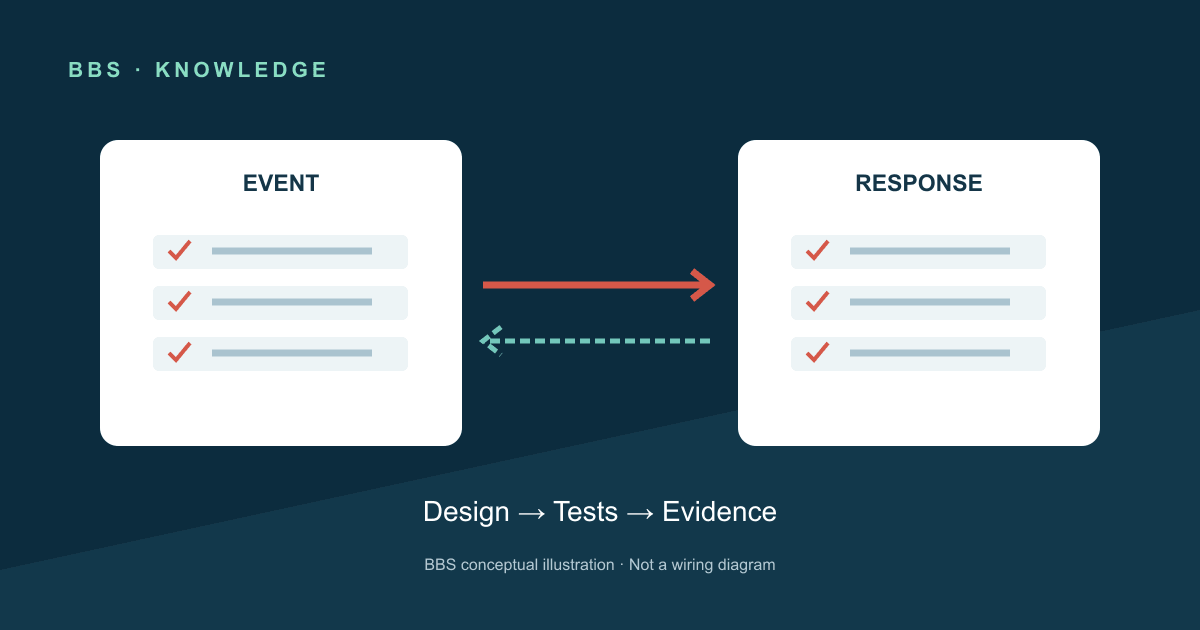
A shared agreement about the expected response
A cause-and-effect matrix links each initiating event to an approved response. It lets the office team, building operator and system contractors agree what will be tested before changing the installation.
Conceptual scoping example. This is not an approved sequence of operations.
| Input | Response to define | Test evidence |
|---|---|---|
| Office alarm event | Identification and response under the approved design | Records at both ends and observed response |
| Supervisory condition | Distinct annunciation at the intended destination | Identifiable source and event type |
| Interface fault | Trouble reporting defined by the architecture | Fault detection and restoration verified |
| Building command | Only the actions authorised in the matrix | Outcome, operating boundaries and restoration documented |
Make the matrix testable
Define the input
Record the source, location, event type and way it will be safely verified.
Specify the response
Name the destination and required action; include timing or conditions only when established by the design.
Assign responsibility
Identify who coordinates the test and who confirms each system response.
Retain evidence
Record expected and actual results, event timestamps, deficiencies, restoration and acceptance.
Before, during and after testing
Initial diagnosis
Inventory, fault history, versions, licences and recoverable backups. Prioritise life safety and operational continuity.
Intervention plan
Agree scope, permissions, responsible teams, contingency, work window and acceptance criteria.
Execution and testing
Apply change control and test the authorised interfaces with both the office and building representatives.
Closeout and follow-up
Deliver test records, open items, recommendations and results reviewed with the client.
Closeout checklist
- Approved matrix revision and test protocol, with a responsible person for each interface.
- Validated backups and a contingency plan before any critical change.
- Coordinated work window, notifications and agreed controls for any impairment.
- Evidence of alarm, supervisory, trouble and command behaviour within scope.
- Restoration checks, open deficiencies, responsible owners and acceptance recorded.
Examples are for scoping and review. They do not prescribe evacuation zones, automatic lift sequences, HVAC shutdowns or access-release programming for your site. Those decisions require the approved fire strategy and responsible engineers.
Continue exploring
- Office fire alarm separation with Honeywell XLS
- Fire alarm interconnection between an office and its building
- NFPA 72: understanding your building’s fire alarm system
Technical references
NFPA 72 · official code page · consulted 2026-10-01
https://www.nfpa.org/codes-and-standards/nfpa-72-standard-development/72
RNE · Ministerio de Vivienda, Construcción y Saneamiento · consulted 2026-10-01
https://www.gob.pe/institucion/vivienda/informes-publicaciones/2309793-reglamento-nacional-de-edificaciones-rne
LET’S TALK