

Practical guide
NFPA 72: understanding your building’s fire alarm system
A visual introduction to detection, notification, power, interfaces and testing, with official references and guidance for planning an assessment.
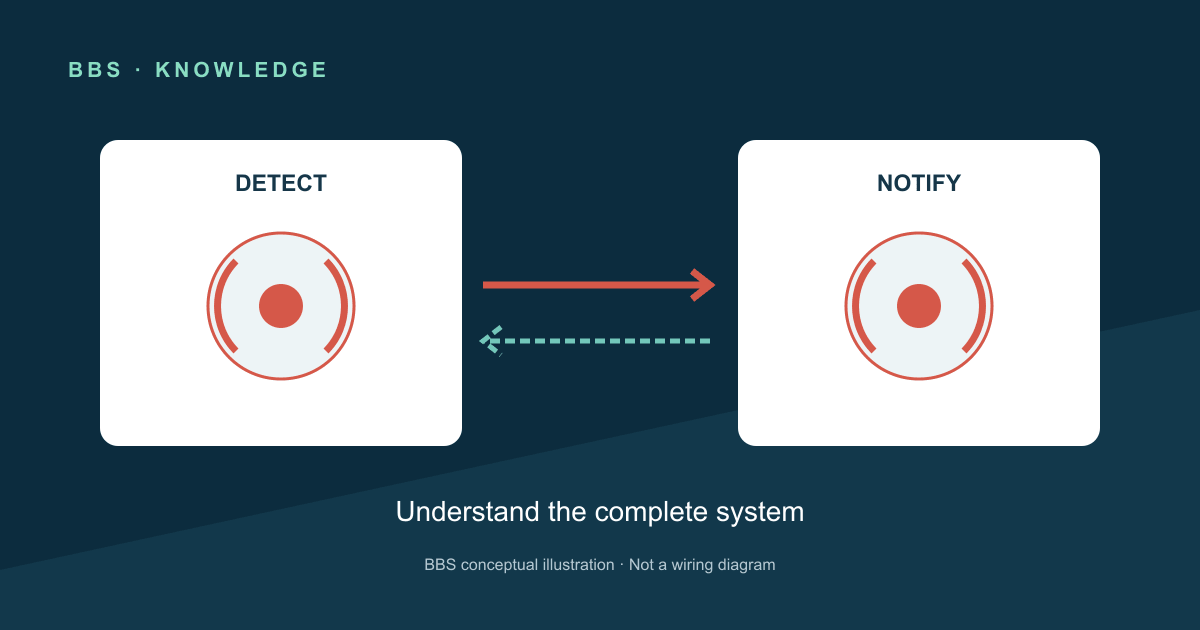
Start with the complete system
NFPA 72 is the National Fire Alarm and Signaling Code. For an owner or property manager, an effective assessment connects detection, notification, supporting power, interfaces and documented tests. Counting detectors is only one part of that review.
Detect and identify
Relate each initiating device to its location, application and panel record.
Notify people
Review the approved occupant-notification strategy, audible and visible coverage, and any voice functions.
Maintain power
Review primary and standby power, calculated loads and the condition of the installed equipment.
Coordinate interfaces
Identify authorised functions with other systems and the responsibility of each team.
Verify performance
Plan inspections and tests by applicable requirements, manufacturer instructions and installed conditions.
Keep evidence
Maintain drawings, configuration records, results, open items and changes under controlled access.
Recognise the type of event
Alarm
A condition requiring an emergency response, such as a fire initiation event.
Supervisory
An abnormal condition in a monitored system, such as a sprinkler valve out of its normal position.
Trouble
A fault in the fire alarm system or communication path.
Evacuation command
A control action defined by the approved matrix, not a fourth event category equivalent to the first three.
Introductory concepts: NFPA · Fire Alarm Basics. Application to an interface is a project engineering decision.
From a presentation to a project decision
Training material can help explain a topic. For a technical decision, record the adopted edition, the complete requirement, manufacturer instructions and the site conditions. A course exercise is not an approved design for another building.
Symbols in drawings must follow the project’s adopted convention and applicable standard. The diagrams in these BBS guides are explanatory illustrations, not a certified NFPA 170 symbol library.
Consult the original references
NFPA identifies the current edition of NFPA 72 as 2025 on its official page, checked on 1 October 2026. The edition applicable to a particular project must still be established with the responsible designer and authority having jurisdiction.
In Peru, review the applicable Reglamento Nacional de Edificaciones (RNE), including A.080 for offices and A.130 for safety, together with the approved project documents. Do not transfer a paragraph number from a presentation without checking its edition and complete context.
NFPA 72: official editions and access · RNE: official Ministry of Housing source
Open NFPA’s Fire Alarm Basics fact sheet (English PDF)
Prepare an assessment
- Identify the approved drawings, maintenance history and responsible technical team.
- List operational restrictions and known deficiencies without exposing passwords or sensitive plans.
- Define the decision needed: correction, extension, modernisation, maintenance or supply.
Continue exploring
- Office fire alarm separation with Honeywell XLS
- Fire alarm interconnection between an office and its building
- Fire alarm cause and effect: from design to acceptance tests
Technical references
NFPA 72 · official code page · consulted 2026-10-01
https://www.nfpa.org/codes-and-standards/nfpa-72-standard-development/72
RNE · Ministerio de Vivienda, Construcción y Saneamiento · consulted 2026-10-01
https://www.gob.pe/institucion/vivienda/informes-publicaciones/2309793-reglamento-nacional-de-edificaciones-rne
LET’S TALK