

Practical guide
Fire alarm interconnection between an office and its building
Distinguish alarm, supervisory and trouble signals from evacuation commands. What the office, property manager and technical teams must agree.
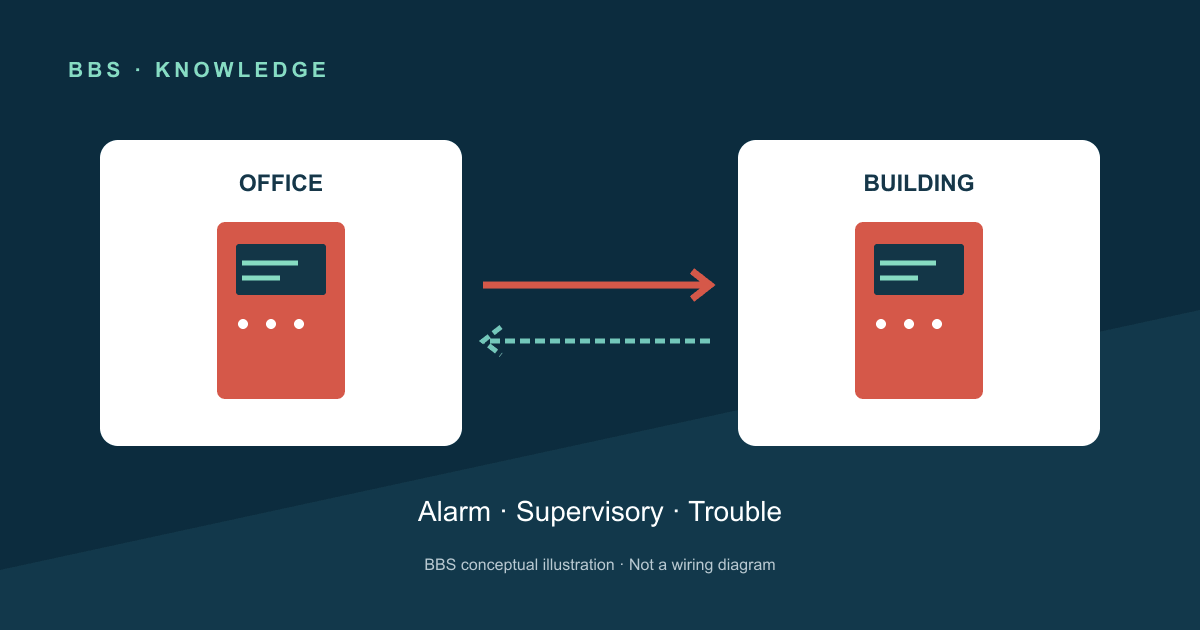
Understand the interface before choosing equipment
A dedicated office panel and the building panel have different operating boundaries, but the required emergency responses must work together. A shared manufacturer name does not establish electrical or network compatibility.
Office control panel
Own devices and circuits
Building control panel
Coordinated operation and response
Three conditions and a separate command
Alarm
A condition requiring an emergency response, such as a fire initiation event.
Supervisory
An abnormal condition in a monitored system, such as a sprinkler valve out of its normal position.
Trouble
A fault in the fire alarm system or communication path.
Evacuation command
A control action defined by the approved matrix, not a fourth event category equivalent to the first three.
Introductory concepts: NFPA · Fire Alarm Basics. Application to an interface is a project engineering decision.
Four decisions for the engineering review
Architecture
Identify both panels, interface models, firmware and supervised paths. Determine which approved interface method fits the installation.
Control authority
Define acknowledgement, silence, reset, evacuation and restoration responsibilities. Document local and remote functions.
Emergency sequence
Set destinations, priorities, timing and authorised dependencies in the cause-and-effect matrix.
Acceptance
Test event identification, interface fault reporting and agreed commands together. Record the results and unresolved items.
What should not be assumed
- An interface diagram is not a wiring diagram. Terminal assignments, resistor values and programming come from approved engineering and the applicable manuals.
- A shared fault contact does not necessarily identify every source. Define the level of annunciation required by the project.
- A new tenant panel does not automatically authorise changes to building evacuation, HVAC, lifts or access-release functions.
- An operational certificate or compliance statement needs an agreed scope, evidence and competent sign-off; installing a panel alone does not establish compliance.
Standards and document control
NFPA identifies the current edition of NFPA 72 as 2025 on its official page, checked on 1 October 2026. The edition applicable to a particular project must still be established with the responsible designer and authority having jurisdiction.
In Peru, review the applicable Reglamento Nacional de Edificaciones (RNE), including A.080 for offices and A.130 for safety, together with the approved project documents. Do not transfer a paragraph number from a presentation without checking its edition and complete context.
NFPA 72: official editions and access · RNE: official Ministry of Housing source
This BBS guide develops office-to-building coordination criteria. Its conceptual illustration does not reproduce a prescriptive NFPA wiring detail or replace the code, manufacturer instructions or project approval.
Continue exploring
- Office fire alarm separation with Honeywell XLS
- NFPA 72: understanding your building’s fire alarm system
- Fire alarm cause and effect: from design to acceptance tests
Technical references
NFPA 72 · official code page · consulted 2026-10-01
https://www.nfpa.org/codes-and-standards/nfpa-72-standard-development/72
RNE · Ministerio de Vivienda, Construcción y Saneamiento · consulted 2026-10-01
https://www.gob.pe/institucion/vivienda/informes-publicaciones/2309793-reglamento-nacional-de-edificaciones-rne
LET’S TALK