

Technical note
JCI IFC2-3030 and Honeywell XLS4000: assessing a modernisation
Honeywell documentation provides a basis for assessing whether certain JCI IFC devices can be retained when upgrading to XLS4000. Feasibility depends on exact models, their condition and project requirements.
Models discussed: M300MJ, M300RJ, J2351, J2351T, 2351J, XLS4000, IFC2-3030
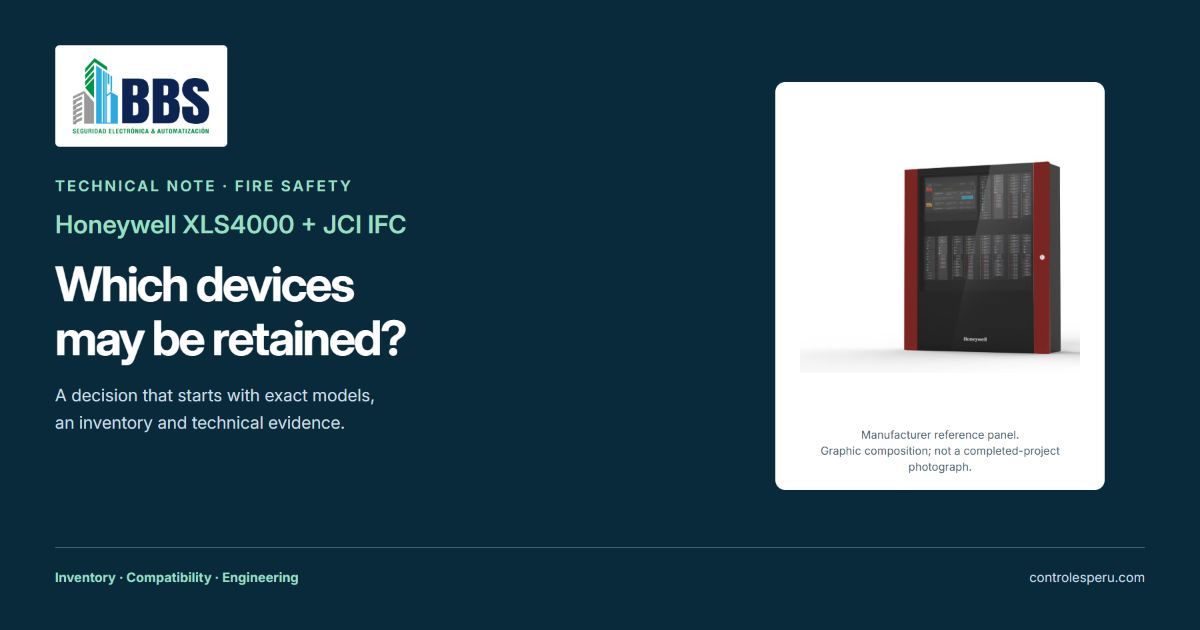
If your building uses JCI IFC2-3030, assessing XLS4000 starts with the panel, loop and installed-device inventory. The Honeywell PDF documents specific devices; it does not itself approve replacement of an entire IFC2-3030 panel.
Before replacing everything, identify what is installed
For a building owner, a fire alarm upgrade raises an important question: must every detector and module be replaced as well? The answer should start with an inventory and the technical documentation for the installed models.
Honeywell’s Johnson Controls IFC/Honeywell Compatibility Document, LS10200-000HW-E, revision A, dated January 27, 2025, provides a basis for assessing whether certain JCI IFC devices can be retained in an upgrade to the XLS4000 Series. This is an option to evaluate; the final scope depends on the exact models, their condition and the installation requirements.
Read the Honeywell document
LS10200-000HW-E · Revision A · 27 January 2025 · PDF in English · 3 pages.
Complete, unmodified copy of the manufacturer’s document. Review Tables 1, 2 and 3, including the conditions for legacy devices.
What Honeywell’s document establishes
The scope is limited to the devices and accessories expressly listed for XLS4000 Series fire panels. The tables distinguish general references from Canadian models. Full part numbers matter: a letter or suffix can identify a different reference.
- Table 1 — Compatible Modules, page 1: identifies JCI addressable modules and accessories alongside Honeywell references.
- Table 2 — Addressable Detectors, page 2: lists the detector models included in this relationship.
- Table 3 — Legacy Devices, page 2: lists older devices subject to additional conditions.
The examples below use the general columns, without Canadian model suffixes. They do not replace a review of the complete tables:
| JCI reference | Listed Honeywell reference | Source |
|---|---|---|
| M300MJ | TC809A1059 | Table 1 · p. 1 |
| M300RJ | TC810R1024 | Table 1 · p. 1 |
| J2351 | TC806B3010 | Table 2 · p. 2 |
| J2351T | TC806B3104 | Table 2 · p. 2 |
| 2351J | TC806B1076 | Table 3 · p. 2 |
J2351 and 2351J are different references. The first appears in table 2; the second in table 3. A readable identification label is therefore more useful than the brand name alone.
The specific condition for legacy devices
The document states that the products in table 3 and their compatibility with the control units were evaluated by UL. It also states that these devices do not comply with the UL standards identified as the latest applicable standards in the January 2025 document and may only be used in retrofit applications, subject to approval by the local Authority Having Jurisdiction (AHJ).
This does not certify the complete installation or provide automatic approval for Peru. The condition must be assessed for the individual project.
What should be checked before defining an upgrade
BBS engineering recommendations: in addition to checking each part number against the document, we recommend reviewing physical and operational condition, system architecture, panel configuration, versions and operating requirements. These project checks are separate from the manufacturer’s documented model relationships.
The cited document does not establish compatibility for all Johnson Controls equipment, Simplex or other product families. Nor does it justify promising that every device, base, cable or accessory can be retained.
The assessment should also identify interfaces with access release, video management, building automation and backup power, together with the tests required to verify their authorized functions.
Why the inventory or BOM matters
A Bill of Materials (BOM) allows the installation to be assessed by exact reference and quantity. It should identify panels, boards, modules, detectors, bases, power supplies and accessories, along with their locations and known condition.
This helps distinguish candidates for retention, components needing further review and items for which replacement should be evaluated. A decision should not rely solely on the system being “JCI”.
BBS ENGINEERING APPROACH
- 01Inventory
Panel, loops, versions and complete codes.
- 02Document review
References, legacy conditions and interfaces.
- 03Installation assessment
Condition, architecture, contingency and tests.
The assessment classifies each reference:
- Candidate for retention
- Pending validation
- Renewal subject to assessment
BBS decision framework. Classification and acceptance criteria are validated for each project; this diagram does not approve a migration.
How BBS can assess the scope
- Initial assessment: review the inventory, fault history, versions, documentation and available backups; prioritize findings by criticality.
- Intervention plan: define alternatives, scope, responsibilities, operating coordination, contingencies, a work window and acceptance criteria.
- Execution and testing: carry out the approved scope under change control and verify authorized interfaces.
- Closeout and follow-up: provide test evidence, outstanding items, recommendations and outcomes validated with the client.
Once the project is defined and a BOM is available, the need for specialist assistance can be assessed, including manufacturer TAC support where appropriate. Eligibility, scope and commercial terms must be confirmed; support is not assumed to be free, unlimited or automatically included.
BBS, an authorized Honeywell Building Solutions distributor and integrator in Peru, can help organize this assessment and prepare an upgrade scope. This is a document-based technical note, not a report of a completed migration or a client outcome.
What to provide for an initial assessment
- Site, building use, upgrade objectives and operating restrictions.
- An inventory or BOM with full model numbers, quantities and locations; identify any information still to be confirmed.
- Readable photographs of equipment fronts and accessible identification labels.
- Available drawings, architecture diagrams, fault history, maintenance reports and previous test records.
- Known system versions and confirmation that backups exist, including their dates. Do not send passwords or sensitive configuration files through public channels.
There is no need to open energized equipment or intervene in the system to request an assessment. Site inspections and testing should be coordinated with the responsible technical professional and building operations.
Technical references
Honeywell. Johnson Controls IFC/Honeywell Compatibility Document. LS10200-000HW-E, revision A, January 27, 2025. Page 1: scope and table 1, Compatible Modules. Page 2: table 2, Addressable Detectors, and table 3, Legacy Devices, including its conditions.
Complete document (PDF): https://controlesperu.com/wp-content/uploads/2026/09/Honeywell-LS10200-000HW-E-Rev-A-2025-01-27.pdf
LET’S TALK