

Practical guide
Forge Cognition: AI for building operations in Peru
AI agents and digital twins: what is changing, the decisions they can support and how to prepare a measurable building pilot in Peru.
Models discussed: Forge Cognition, Honeywell EBI
What changes: from monitoring to decisions
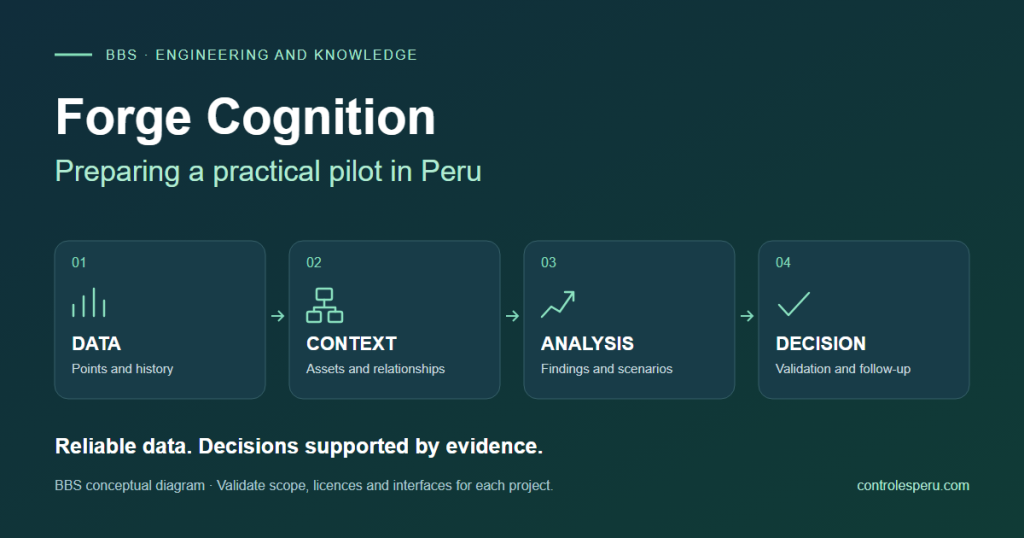
The advance combines asset context and scenario evaluation. BBS evaluates its value by whether it helps select an action, verify it and follow its result.
AI agents
Help relate signals, events and history when investigating an operating condition.
Digital twins
Support evaluation of operating scenarios before deciding on an intervention.
Condition-based maintenance
Directs review towards assets showing deviations; engineering confirms the finding.
Decisions for administrators. Criteria for engineers.
Decide where to invest first
Relate recurring faults, continuity, comfort and operating cost. Ask for evidence, responsible owners and a before-and-after comparison to prioritise corrective work and investment.
What to measure →Turn signals into a diagnosis
Validate points, historical data, states and interfaces. Check hypotheses against equipment and document the cause, intervention, tests and result.
Prepare the pilot →BBS application guidance. A building generates data; turning it into useful decisions requires understanding what it represents, checking its quality and assigning responsibility for action. This guide proposes a practical assessment in Peru. It does not document a BBS Forge Cognition deployment or BBS pilot results.
What was announced and how to read the figures
Honeywell introduced Forge Cognition on 14 October 2026: artificial intelligence (AI) agents and digital twins for facility operations, with NVIDIA and Dell Technologies technology. Its Voyager pilot reports up to 90% fewer unnecessary alerts and up to 10% potential energy and utility reduction identified. Read Honeywell’s official announcement.
The 10% is an identified opportunity, not savings already achieved at a Peruvian building. The 90% concerns building-management alerts: it does not establish a reduction in fire alarms or justify disabling detection, notification or safety interfaces. These are manufacturer-reported pilot findings, not BBS targets or guarantees.
From data to a digital twin: establish a reliable foundation
A building management system (BMS) supervises points, equipment and events. A digital twin connects a representation of the installation with real-world data to analyse its behaviour; a stand-alone 3D view does not establish that connection. NVIDIA describes this relationship between the model and actual operations.
Each asset should be traceable to its site, zone, function and operating points. A temperature without units, duplicate alert or frozen signal can lead to a wrong conclusion. Review naming, units, scaling, timestamps, calibration, missing-data periods and access permissions first. Then decide which information is useful for the selected case.
Applying the approach to a building in Peru
BMS with reliable historical data
Prepare a focused HVAC or operational-alert pilot. Review models, releases, licences, documentation and permitted interfaces; having Honeywell EBI does not establish that Cognition is included or enabled.
Mixed installation or incomplete records
Prioritise inventory, measurement, communication recovery and data organisation. Mixed brands or BACnet alone do not establish interoperability. Validate integration through devices, services, architecture and testing.
Limited instrumentation
Start with the problem and the information needed to measure it. Basic trends and maintenance records may be the first step; size the platform, modelling and infrastructure after establishing the need.
Several operational owners
Define who authorises data and actions, which assets serve common areas and which belong to independent installations. Agree responsibilities with administration, operations and owners before integrating information.
Use the site’s actual schedules, occupancy, climate, loads and operating restrictions. For an office building, investigate whether equipment runs outside approved hours; for a campus, whether repeated alerts obscure recurring faults. These are assessment examples, not customer results. Comparing periods without adjusting those conditions can confuse an operational change with an improvement.
Before procurement, confirm availability and scope for Peru, supported interfaces, licences, processing location, infrastructure, connectivity, maintenance and support responsibilities with the provider. A public launch announcement does not replace that validation or a proposal for the installation.
A first pilot with a clear decision and boundary
BBS recommends starting with an observable problem, an asset group and an accountable owner: for example, prioritising recurring HVAC alerts. Agree which data can be used, how each finding will be verified and what evidence supports continuing. In the initial assessment, prioritise observation and recommendations with human review.
Any controller write, setpoint change or equipment action is an additional intervention requiring engineering, permissions, backup, a work window, contingency and restoration tests. AI classification must not remove the original event’s traceability or replace operational responsibility.
Operational technology (OT) governs physical processes and must protect safety and continuity. Assess network segmentation, least privilege, authorised remote access, action logs and recovery. NIST SP 800-82 Rev. 3 provides a technical reference framework; it does not itself establish compliance for a Peruvian installation.
The BBS method: four stages and closing evidence
- Initial assessmentInventory, faults, data, releases, licences, backups and criticality. Deliverable: gaps and prioritised use cases.
- Intervention planPilot scope, permissions, owners, authorised data, contingency and acceptance criteria. Deliverable: an approved plan.
- Execution and testingData and authorised-interface validation, finding checks and change control. Deliverable: test records and observed results.
- Handover and follow-upResults, limitations, corrective actions, owners and new measurement. Deliverable: a report supporting correction, expansion or stopping the pilot.
A useful finding identifies the asset, evidence, impact and recommended action. Where appropriate, it becomes a corrective-work or modernisation scope; its outcome is then verified. Generating more alerts or reports does not replace resolving the causes of faults.
What to measure before deciding to expand
- Data quality: coverage of agreed points, missing-data periods, consistent units and time synchronisation.
- Alert usefulness: events reviewed by operators, confirmed classifications, duplicates and relevant faults the analysis missed. A lower volume is insufficient if important events are lost.
- Maintenance: field-confirmed findings, closed corrections, recurring faults and response time, compared with a documented baseline.
- Energy and comfort: measured consumption under comparable operating conditions. Separate estimated opportunity, measured savings and the effect on billing.
Verify savings against an adjusted baseline and a comparable subsequent period. Account for weather, occupancy, schedules, equipment changes and tariff structure; simulating an improvement does not prove implementation. FEMP measurement and verification guidance helps structure this method; it is not a universal Peruvian legal requirement.
Project requirements and data in Peru
Identify the Peruvian National Building Regulations (RNE) and approved project requirements relevant to HVAC, installations and safety. AI analysis is not a technical inspection, an operational certificate or approval for a change.
When using video, access records or information identifying people, review purpose, permissions, access, retention and providers under Peru’s data-protection framework. Prefer technical telemetry and aggregated information where sufficient. Consult the National Personal Data Protection Authority’s reference and regulations applicable to the specific scope.
Questions to resolve before investing
Can it be activated on any Honeywell EBI installation?
Do not assume so. Request validation of the release, architecture, interfaces, licences, equipment and service availability for the site. This guide does not confirm an upgrade path or support for a specific inventory.
Must the whole building be modelled first?
Define the problem and the information required to assess it first. The twin’s scope and fidelity should follow the use case and selected solution’s requirements, rather than a visualisation that cannot support verifiable decisions.
What should be sent to BBS?
Site and occupancy, available inventory, supervisory system, priority problem, schedules, maintenance history and authorised samples of trends or events. Share technical information without credentials or identifiable personal data.
Request a building data-readiness assessment →
What does the EBI One reference add?
Honeywell presents EBI One – Powered by Forge Cognition with contextual information and operating workflows. This helps frame questions about integration and evolution; it does not establish those features in an installed EBI release or confirm commercial availability in Peru.
Sources and scope
Public sources checked on 15 October 2026. Application and measurement recommendations are BBS planning criteria; feasibility is validated for each project. Where the scope requires it, test protocols and reports need the appropriate qualified professional’s signature.
- Honeywell · Forge Cognition announcement, 14 October 2026
- NVIDIA · digital twins linked to real-world data
- NIST SP 800-82 Rev. 3 · operational technology security
- U.S. DOE / FEMP · measurement and verification, version 5.0
- Peruvian Ministry of Housing · National Building Regulations
- ANPD · Personal Data Protection Law regulations
LET’S TALK